
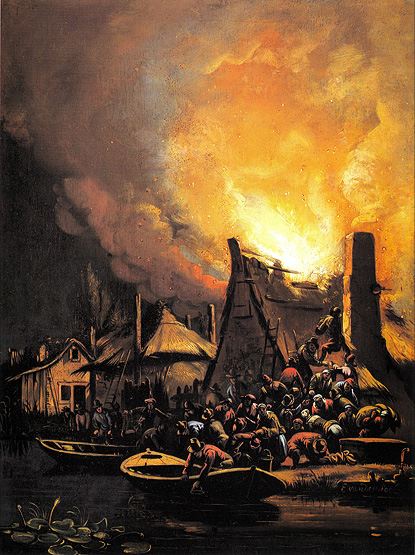
The Nocturnal Fire
EGBERT VAN DER POEL
(Delft 1622 – Rotterdam 1664)
Oil on Panel. 35,5 cm. x 26,7 cm. Signed Work. 1650-60 ca.
Egbert van der Poel is known world-round for his different versions of the Delft Explosion, also known historically as the Delft Thunderclap of 1654. This painting, although it does not portray the historic moment, shows a nocturnal fire that reminds the viewer of his other works because of its similarity in terms of composition. Van der Poel’s mastery is clear when it comes to capturing the fire’s diverse tones, as well as the lights and shadows, which he produces over the elements of the composition.
Egbert van der Poel was born in 1621 in the city of Delft, where he lived for a long period of time, participating in the Guild (artists trade) beginning approximately in October 1650. Around the year 1655, Van der Poel moved to Rotterdam, the city in which the artist would eventually die in 1664. The painter was very popular during his time in Holland and was characterized by his highly descriptive genre paintings and his signature paintings of nocturnal fires. Van der Poel specialized in painting the Delft explosion that happened in 1654. In his works he enjoyed representing daily life scenes of villagers: housewives busy in the kitchen surrounded by pans, pots, dogs, chickens, meats, etc. Another common subject for Van der Poel’s paintings were stables and farmers with animals and their working tools. All of the painter’s figures, as well as the color range he chose, show the influence of Adrian van Ostade. Van der Poel’s color palette mainly includes browns, ochers, and dark greens, with a radical combination of red. This artist also painted exteriors with the typical house at an angle, with the peasants depicted with their farming tools, bright copper pails, and working gear. The anecdotic touch is given by the chickens that appear about the characters. This type of painting, and some winter landscapes, were executed in the period prior to 1654. Years before, Van der Poel painted numerous fire and nocturnal scenes, views of the city of Delft before and after the great explosion in 1654. In the works where he represents nocturnal fires, the viewer can appreciate the fire’s light force, full of figures trying to put the fire out. These works really follow the chronological order of the catastrophic events of the time. In some occasions, Van der Poel’s paintings have been mistaken and compared to the ones of Saftleven, H.M. Sorgh, Hubert van Ravesteyn y H. Potuijl, and even to the ones of A. Van Ostade. D.Vosmaer frequently imitated the artist’s fire scenes of the city of Delft.
BIBLIOGRAPHY
- W. Bernt, “Die Niederlandische Maler des XVII Jarhunderts”, 1979, Vol.II 980 –982
- N. MacLaren, “National Gallery Catalogue. Dutch School London”, 1960, p. 291
- W. Stechow, “Dutch Landscape Painting of the Seventeenth Century”, London, 1968
- “The National Gallery Complete Ilustrated Catalogue”. Compiled by Christopher Baker and Tom Henry
- E. Benezit, “Dictionnaire des Peintres…”, Vol. 11, p. 77
- Arthur K. Wheellock, “The Public and the Private in the Age of Vermer”, 2000, p. 64 – 71
- Christopher Wright, “Dutch Painting in the Seventeenth Century Images of a Golden Age in British Collections”, p. 105, 230
PROVENANCE
Private Collection, Nueva York
MUSEUMS
Egbert van der Poel’s works can be found in many museums around the world including: Amsterdam- Rijksmuseum, BerlIn- Gemaldegalerie, Delft- Stedelijk Museum “Het Prinsenhof”, Dublín- National Gallery, Glasgow- Art Gallery, The Hague- Museum Bredius, London- National Gallery, Manchester- City Art Gallery, Paris- Louvre Museum, Rotterdam- Historisch Museum, Museum Boymans van Beuningen, San Petersburgo- Hermitage, Vienna- Liechtenstein Collection.