
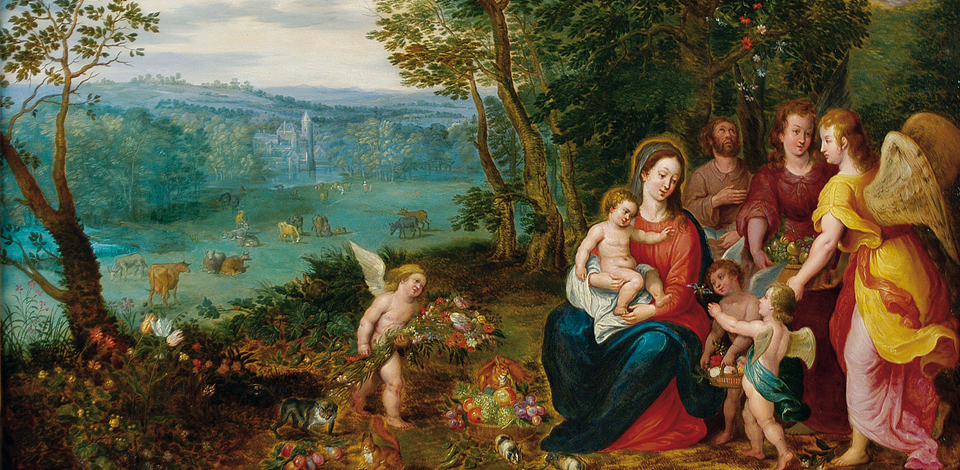
The Flight into Egypt
JAN BRUEGHEL II (Antwerp 1601 – 1 Sept 1678)
HENDRICK VAN BALEN (Antwerp 1571 – 17 July 1632)
Oil on Panel. 54,7cm. x 87,2cm.
This work, certificated by Dr. Klauz Ertz as The Flight into Egypt, represents the narrative in the New Testament. This biblical event is described in the Gospel of Matthew (Matthew 2:13-23); Joseph fled to Egypt with his wife Mary and infant son Jesus after a visit by the Magi because they learned that King Herod intended to kill the infants of that area. After a time Joseph and the others return from Egypt, the text stating that their enemies had died. Matthew 2:15 cites Hosea 11:1 as prophetically fulfilled in the return of Joseph, Mary and Jesus from Egypt.
H. van Balen was one of the most important artists in the history of Flemish art. The artist worked with Adam van Noort in the city of Antwerp. In 1592/1593 he became Master of the Guild of Saint Luke of Antwerp. According to the documentation of the time, it is deduced that he visited Italy at some point in his life. In 1605, Balen married Margaretha Briers and had three children who followed in their father’s footsteps as artists. The children’s names were Gaspard, Jan y Hendrick II. In 1609/1610, Balen became the Dean of the Guild of Saint Luke of Antwerp and in 1613, the Dean of the Romanist Guild. H. van Balen had twenty-six disciples, the most notable of which were A. van Dyck, N. van Kessel, J. de Monper, Fr. Snyders, J.Tilens, S.Vrancx, J.Wildens, G. de Wit, and L. van Uden. The painter was highly influenced by his teacher A. van Noort and the Venetian School; his style also resembles the tendencies of H. Rottenhammer. H. van Balen’s compositions were mainly done in small format using oil and panel. The artist collaborated with different artists such as Jan Brueghel with whom he created The Flight into Egypt.
BIBLIOGRAPHY
- J. de Mere y M. Wabbes, Edited by Dr. Jennifer A. Martin, “Illustrated Dictionary of 17th Century Flemish Painters”, Texto, p. 83-84
- J. de Mere y M. Wabbes, Edited by Dr. Jennifer A. Martin, “Illustrated Dictionary of 17th Century Flemish Painters”, Plates A-K, p. 178-184
- M.L. Hairs, “Les peintres flamands de fleurs(…)”, Brussels, 1985
- Idem in Brueghel, “Une dynastie de peintre”, exh. Cat., Brussels, Palais des Beauz Arts, 1980
- K.Ertz, J.Br. der Jüngere, “Die Gëmalde mit kristischen”, Eurekatalog, Freren 1984
- M.L. Hairs, “Jan. Br. Le Jeune peintre de fleurs”, in rev, B.A.H.A, VI, 1967, p. 57-74
- E. Duverger en D. Maufort, “Het Antwerpse kunstenaarsgeslacht Tijssens (Thyssens) uit de zeventiende eeuw en het begin van de achtiende eeuw en zijn stamvader Augustijn Tijssens de Oude”, Gentse Bijdragen 31 (1996), p. 127-207 [archivalia betreffende Jan Breughel II]
- S.D. Muller, “Nature’s rivals: the Brueghels”, in: S.D. Muller (ed.), The Val A. Browning collection: a selection of old master paintings, Salt Lake City (The Utah Museum of Fine Arts, University of Utah) 2001, p. 62-93
- An Van Camp, “Jan Brueghel the Youngher and the Nuremberg drawings, Delineavit et Sculpsit nr. 36 (oktober 2013), p. 22-43
- Chr. Van Mulders, “Een analyse van de creatieve process (sic) in het oeuvre van P.P. Rubens in samenwerking met Brueghel I en II”, diss. in voorbereiding, Brussel, Vrije Universiteit, prof. Van de Velde (Bron: Kunstchronik 9/10 (2003), p. 536
MUSEUMS
Jan Brueghel’s works can be found in many museums around the world including: Antwerp- K.M.S.K., Amsterdam- Rijksmuseum, Berlin- Staalt. Preussischer Museum, Kulturbesitz Gg., Detroit (Michigan, USA)- Institute of Art, Dresden- Gemaldegalerie, Dublin- National Gallerie of Ireland, Madrid- Museo del Prado, Munich- London- National Gallerie, Montpelllier- , Munich- , Nantes- , New York- Metropolitan Museum, Philadelphia- Museum of Art, San Francisco, California,- M.H. de Young Memorial Museum, Vienna- Kunsthist Museum.
PROVENANCE
Private Collection, España
EXHIBITIONS
Madrid, Soraya Cartategui Gallery, Feriarte, November 2014.