
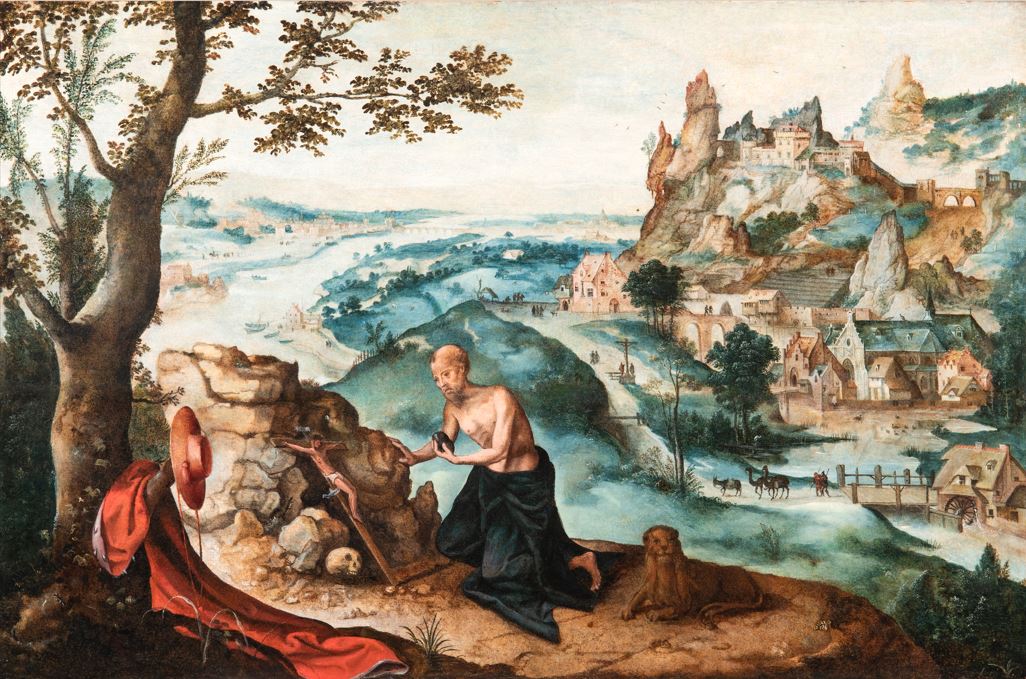
Landscape with St Jerome
LUCAS GASSEL
(Helmond 1490 – Bruxelles 1568)
Oil on panel. 56 x 85 cm. Signed with monogram LG lower left. 1540 ca.
Expertise by Peter van den Brink
We are also grateful to Luc Serck to have fully endorsed the authorship of the work.
Exhibited at TEFAF Maastricht 2022
An artist able to turn topographical gigantism into a veritable work of art, was born around 1500 in the small village of Helmond in the north Brabant. The beginning of the sixteen century was a particularly fruitful period for his artistic style.  The path, that a selected number of painters decided to follow with their ow spin, had been traced by the ‘Father’ Patinir and his nephew Herri met de Bles, also known as Il Civetta. When analysing the development of landscape painting in the sixteenth century, it is paramount to identify and underline the individual features of each artist. As a matter of fact, although the painters shared similar purposes and views, each was able to interpret the theme in a personal way.
Very little is known about the life of the artist. It is speculated that he might have lived in Brussels and travelled to Italy on a few occasions. He was a friend of Dominicus Lampsonius who educated him about geography. Conversely, a lot is known about his pictorial corpus. Gassel had a methodical and calculated artistic personality, less eccentric than Bles’ but by no means Penitent no less creative. The author’s original creations were often repeated in many signed works in which humans and orographic architectures are alternated under the guidance of a keen inventiveness, the ability to imagine creative yet harmonious solutions on a coherent stage. His paintings are like magnificent tales told through images in which each chapter leaves the reader, captivated by a multitude of plots coherently linked together, wanting to read the next. We present you this significant panel which is not only an exceptional addition to the painter’s catalogue, but also an anthological essay of his art. This landscape with Saint Jerome in the foreground was one of the author’s favourite compositions. He made at least two other signed versions of it. One of which is currently kept at the Carlos Slim Foundation in Mexico City (Fig. 1). The peculiarity of this discovery lies in the meticulous restoration work carried out on the painting itself. The panel had been heavily repainted and altered in order to hide some of the composition’s more peculiar details to make the painting appear older than it was. After cleaning it, hidden details such as the skull, the foot of the saint and the authentic features of the old man and the lion (the latter had been completely changed), as well as the LG monogram on a rock near the crucifix emerged. As Luc Serck remarked, the work has thus regained its coherent balance, turning out to be an authentic variant of the Slim version and can therefore be fully attributed to Gassel. Furthermore, a vibrant preparatory drawing shows the variations in makings that Gassel himself must have made on the painting, emphasizing once again the compositional genuineness that can only go alongside a painting of such high quality. The panel dates back to the 1940s and can be compared to other works by the master, especially to the Flight into Egypt which is also known in many variants and has recently been on the market (Fig.2). In addition to the chromatic range and the almost identical arrangement of colours, both works share the stylised naivety of the characters, whether in the foreground or the small silhouettes in the background. Likewise, they share the neurotic design of the various buildings such as taverns, quaint castles, the winding trails, crossroads, rivers and ponds that form intricate paths. In the background imposing, dramatic mountains, that look as if they were made of plasterboard, can be seen. 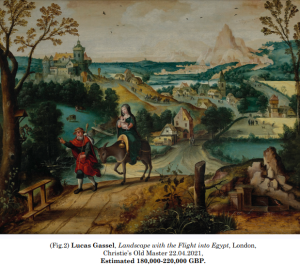 At the centre of a rocky spur, the wise old man with a scrawny body and a serious face is ready to hit himself while contemplating the Salvation represented by the crucifix and meditating on death represented by the skull. His religious artefacts are lying on a large tree, while an odd beast is crouched by his side. After passing an extremely dangerous and steep ridge, a vast landscape unfolds in front of the observer’s eyes. The eyes are not hit by icy hues such as turquoise and blue like in Patinir’s painting, nor by the Bles’ dark hues, but by brown, ochre, yellow and light green shades. This stylistic temperature is better suited to the author’s purposes, which aims at building a “mental topography”, which shows he was clearly influenced by his friendship with Lampsonius and his interest for cartography which became the object of exciting artistic speculations as a result of the geographical discoveries of the time. Along the course of a river that resembles a lake, between a grassy hill and a canyon, a town can be found. It was portrayed down to its tiniest details, resulting in an exquisite catalogue of a precise yet absurd conurbation. The water mill on the right protects a bridge on which two camels have just passed, while on the lake a flock of ducks is swimming along the walls of a town (in Venice or Bruges?) literally leaning against a Gothic cathedral, all shielded by a drawbridge guarded by an outpost on whose side wall red jugs have been hung.
On the trail, at the crossroads, a reassuring crucifix pushes the eye higher up to the sign designating an inn, probably converted from a prominent building no longer in use if the ancient column at the top of the stairs is a logical indication. At the entrance – and just before another dizzying ridge – some wayfarers with their sticks and dogs are walking in small groups. And it is only from this geographical level that it is possible to access the upper town which is perched among gorges and protected by two walls. As a matter of fact, only after passing a large stone bridge (which looks more like an aqueduct) and the first wall on which wooden casemates have been built, one can walk along an immense staircase which was counter-productive for defensive purposes and leaves the way to a steep unpaved climb leading to another arched wall connected to the castle itself. The structure, made up of roofed corridors, towers and a palace, dominates the valley from an overhanging position. It is not hard to imagine that the last arch outside the castle leads to a tiny trail that goes up to the top of the rock, placed above a rocky spur in which human-like features are concealed. On the opposite side in the valley the stream has become a navigable river, full of ports, ships and characters. Miles away a large oriental-looking city spans from one shore to the other, where alterna ted with windmills. Some birds are swirling inthesky, increasing the sense of exhilarating vastness that the scene conveys. This scientific ability as an architect and leader is what has earned Gassel a special place among the landscapers of the sixteenth century. As a matter of fact, the countless architectural structures are shown from a broad and elevated point of view, which underlines the heroic epic nature of the adventurous journey, not focusing on the path’s many dangers, which are prevalent in Bosch and Bles.
The substantial inconsistency of this meticulously depicted orographic architecture is in direct opposition to the Italian-style landscape. These landscapes and architectures are subconsciously accepted by the observer who is brought back to their childhood when they used to look at model towns or at the little houses in the nativity scene. Moreover, the entire composition can be read as Saint Jerome’s penitence spiritual projection. The harshness and the tormented line of the horizon thus symbolises the saint’s inner torment, following the landscape moralising aim that in Bosch and Patinir was defined as “pilgrimage of life”.
BIBLIOGRAPHY
– Kraan, H., Lucas Gassel. Een stilistische en ikonografische beschouwing van zijn werk, unpublished thesis, University of Leiden 1979, p. 81, nos. 2b, 2d, figs. 35, 37
– H. Yeide, N., Beyond the dreams of avarice: the Hermann Goering collection, Dallas 2009, p. 273, no. A324 (as Joachim Patinir)
– Dreyfus, J.M. Le Catalogue Goering, Paris 2015, p. 196-197, no. RM 316/F851, ill.
– Denison Champlin, J., Cyclopedia of painters and paintings, Volume 2. C. 1886
– Hoogewerff, G.J., ‘Lucas Gassel, Schilder van Helmond’, en ” Oud-Holland 53 (1936), p. 37-47
– Bergmans, S., ‘Les éléments nouveaux dans les paysages de Gassel au XVIe siècle’, en: Bulletin Musées Royaux des Beaux-Arts/Bulletin Koninklijke Musea voor Schone Kunsten 8 (1959), p. 135-138
– Genaille, R., ‘Le paysage dans la peinture des anciens Pays-Bas de Patinier à Bruegel’, in: Jaarboek van het Koninklijk Museum voor Schone Kunsten Antwerpen 1987, p. 143-184
– Thieme, U. Becker. F., Catálogo razonado, ‘Allgemeines Lexikon der bildenden Künstler : von der Antike bis zur Gegenwart’, vol. 13 (1920), p. 233.
– Beyer, A., Savoy. B., ‘Saur: Allgemeines Künstlerlexikon : die bildenden Künstler aller Zeiten und Völker’, vol. 50 (2012), p. 42.
PROVENANCE
– Dr. Alfons Jaffé Collection (1861-1948)
– Prof. Paolino Collection (or Paoli) Roma, vendido Goudstikker (en o poco antes de 1928)
– Jacques Goudstikker Gallery, Amsterdam, as ‘Patinir-achtig, Landschap’ (Patinirlike, Landscape (black-book, no. 1981)
EXHIBITIONS
– TEFAF Maastricht, 2022
MUSEUMS
There are works by Lucas Gassel in the museums of the following cities, among others: Royal Museum of Fine Arts, Brussels (Belgium) – Museum of Art of the University of Michigan (USA) – Bonnefanten Museum, Maastricht (Holland) – Museum of Fine Arts , Helmond (Holland) – Louvre Museum, Paris (France) – Rijksmuseum, Amsterdam (Holland) – Royal Museum of Fine Arts, Antwerp (Belgium) – Kunsthistorisches Museum, Vienna (Austria), etc.