
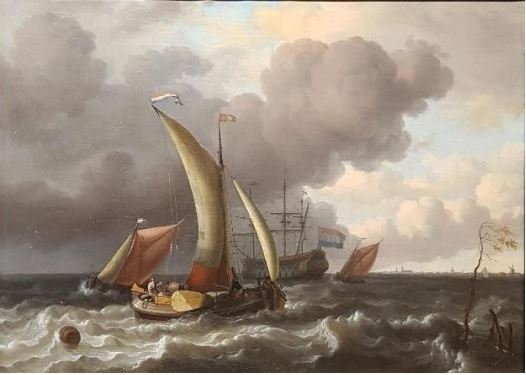
Sailing Ships on a Stormy Sea
LUDOLF BACKUYZEN
(Emden 1631 – Amsterdam 1708)
Oil on panel. 44.5 x 61 cm.Worked signed with the LB initials. 1685 ca.
Ludolf Backhuysen was one of the most important nautical painters of the glorious Dutch Golden Age, the period of the Netherlands’ maximum prosperity ranging between the beginning of the seventeenth century to its end. In our anthological canvas, which can be easily compared to the prestigious Ships in a Stormy Sea, now kept at the Rjiksmuseum (Fig.1). In the foreground a cargo ship, called kaag in
Dutch, can be noticed. It was the typical ship used both for inland navigation and as a ferry in the Zuyder Zee area. The boat is fighting against powerful gusts of wind and is moving towards its berthing in the right corner. On the horizon, a Dutch-flagged merchant ship lowered its sails and dropped anchor due to the impending storm, excellently conveyed by the low leaden clouds swirling from left to right. In this last section one can see in the distance the profile of a quintessentially Dutch town with a windmill rendered through thin and delicate strokes.
The beauty of the painting consists of the subtlety of the meteorological and atmospheric observations that the painter wanted to convey through the expert eye of one who has abandoned his easel to experience the Sea first-hand. After all, the artist was already known at the time for embarking on long voyages in order to be able to study first-hand the sea from an artistic point of view.
This is the prime example of Dutch ethics and aesthetics. Unlike the Flemish artist of Antwerp and Brussels, he was able to adhere to verism in his own way as he was interested in representing life in a realistic manner. The way water splashes moved by the wind contrasting with the direction of the waves is particularly effective, along with the ability to describe the quick pressure drop causing the rain to fall down from the clouds, while above them many kilometres away the sun lights up the upper part of the rainclouds with a pink tinge. The vastness of the Dutch skies thus becomes a crucial metaphor, held very dear by the Calvinist culture of the time. The waves represent life while the rapid weather changes identify luck. All that’s left to the right man is to sail to the best of his ability. If for a few moments the sea proves too hostile, the glorious Dutch civilization will know how to welcome in its safe harbour those who were brave enough to build their own fortunes.
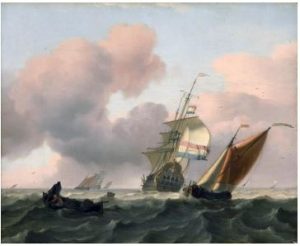
Fig.1, Ludolf Backhuysen, Ships in a
Stormy Sea, oil on canvas, cm 31×39,
1697, Rijksmuseum, Amsterdam.
BIBLIOGRAPHY
– W. Bernt, The Netherlandish Painters of the Seventeenth Century, 1969, Vol. 1, p. 5,
plates 43, 44, 45 y 46.
– R. Preston, Seventeenth Century Marine Painters of the Netherlands, 1974, pp. 3-6.
– K.J. Mullenmeister, Meer und Land im Licht des 17 Jahrhunderts, 1973, Band 1.
– H. Hannen, Ludolf Backhuysen Gesellschaft, Emden 1985.
– G. de Beer, Ludolf Backhuysen, sein Leben und Werk, 2002.
– C. Hofstede de Groot, Catalogue raisonné, vol. VII, Esslingen, 1918.
– F. C. Willis, Niederländische Marinemelerei, Leipzig, 1911.
– L. Preston, Sea and River Painters of the Netherlands, Londres, 1937.
– N. MacLaren, National Gallery Catalogue, Dutch School, Londres, 1960, p. 5.
– E. Benezit, Dictionnaire des peintres…,. tomo 1, 1999, p. 659.
– L. J. Bol, Die Holländische marinemalerei des 17. Jahrhunderts, 1973 Berlín, pp.
301-309
– Catálogo ilustrado, All the paintings of the Rijksmuseum in Amsterdam, 1976, p. 96.
– C. Wright, Dutch painting in the Seventeenth Century. Images of a Golden Age in
British Collection, 1989, p. 165.
MUSEUMS
There are works by Ludolf Backhusen in the collections of museums in the following cities, among others: Rijksmuseum, Amsterdam (Holland) – Royal Museum of Fine Arts Arts, Antwerp (Belgium) – Royal Museum, Berlin (Germany) – Royal Museum of Fine Arts Arts, Brussels (Belgium) – Statens Konstmuseum, Stockholm (Sweden) – Pitti Palace, Florence (Italy) – Hunterian Art Gallery, Glasgow (Scotland) – Mauritshuis, The Hague (Holland) – National Gallery, London (England) – Wallace Collection, London (England) – Roumianzeff Gallery, Moscow (Russia) – Alta Pinacoteca, Munich
(Germany) – Louvre Museum, Paris (France) – Boymans van Beuningen Museum, Rotterdam (Holland) – Hermitage, Saint Petersburg (Russia) – Kunthistorisches Museum, Vienna (Austria), etc.