
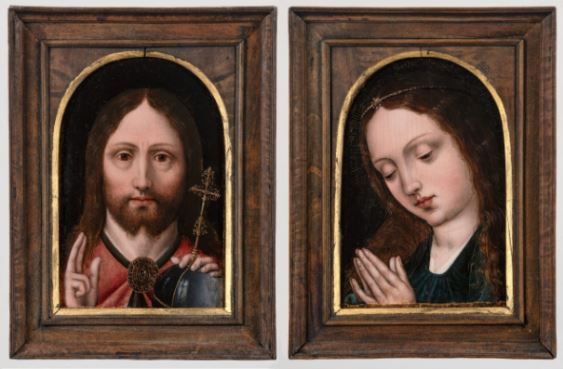
A diptych. Christ Blessing and Praying Virgin
THE BRUSSELS MASTER OF 1520
(Active in Brussels, first half of the XVI Century)
Oil on panel. 12,5 x 8,5 cm. each one (4,92 x 3,34 in.) 1520 ca.
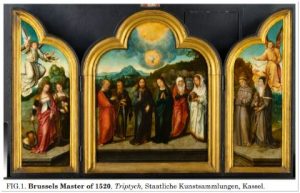
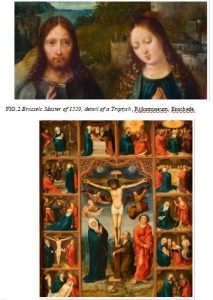
These little panels are by the anonymous hand responsible for a coherent group of paintings formerly given to Bernard van Orley, assembled by Lars Hendrikman around the dated 1520 Altarpiece of the Death of the Virgin (Musée de l’Assistance Publique). To this “Brussels Master of 1520” should also be given a small triptych of standing saints (FIG.1) in the Staatliche Kunstsammlungen, Kassel, two standing Virgins in the Prado (FIG.3) and Museo Thyssen-Bornemisza in Madrid, and a triptych in the Rijksmuseum, Enschede (FIG.2)
.
.
.
.
.
.
.
.
.
.
.
.
.

.
As suggested by Veronique van der Bucken, on evaluation from photos, the works also show connections with the so called “van Orley group”, a collection of paintings certainly related to the master and executed by his entourage. There are also obvious connections with Jan van Coninxloo II, also closely related to Van Orley: in particular, with some characteristics that can be found in a Madonna and Child (FIG.4) on the market a few years ago. In this work, we recognize the same way of making the hands, the physiognomy of the eyes, the oval of the face and the range of colors used. Also, there are some connections with the more mysterious Master of Beighem Altarpiece an artist of eclectic inspiration with an interest in the ornate of classical taste, typical of van Orley. Basically, it is plausible to place the two small works in the diffusion of van Orley’s style and in the group of artists closely connected to him, towards the second decade of the sixteenth century.

The Christ, on the other hand, while certainly also reconnecting with the models, seems to be very close to some works of  Flemish illuminated manuscripts, such as the Blessing Christ in the Psalter of Henry VIII (Fig.5), although having to admit that this typology of Christ is almost a sort of icon idiosyncratic of the Flemish art, in almost infinite variations.
The small panel shows a portrait of the Virgin Mary with hands folded, in front of a dark background. The delicate flesh tones of her face and hands, are well executed. The panel is an excellent work of the transitional period between late gothic and Renaissance art of the Netherlands in the early 16th century.
These pictures were produced in small format for bourgeois clients for personal devotion. The Madonna was worshiped as mediator according to her theological role as intercessor between those praying and the Son of God. Small enough to be hand held, this mesmerizing image of Christ ultimately derives from ancient Byzantine prototypes of the Christ Pantokrator that adorned monumental interior domes, like the Basilica of San Marco in Venice, as well as diminutive mosaic icons. Such images were extremely popular in the late Middle Ages and early modern period, due to their appearance in the southern Netherlands, where they were brought back from the Holy Lands by pilgrim travelers and imported through trade relations between Flanders and Crete. Some found their way into the collections of the dukes of Burgundy and their courtiers. All this type of subjects with Christ Blessing descended -in the beginning- from previous early Netherlandish adaptations of Byzantine icons, namely Robert Campin’s Christ Blessing and the Virgin in Prayer of about 1425–30 (Philadelphia Museum of Art; fig. 6), where the figures are intentionally tightly cropped to achieve a dramatic close-up image. Campin additionally transformed his Byzantine model, rejecting its schematic facial features, and flat, decorative gold striations for the folds of garments. Most importantly, borrowing from the conventions of portraiture, he added the hands of

Christ, his right hand raised in blessing, and his left hand resting on the frame edge. Thereby, he established a sense of the physical presence of the figure in the space of the viewer. The devotional function of the panel is enhanced by the painter’s great subtlety of expression in the face and above all in the hands that help to convey the meaning of the image. Such an approach elicits an empathic response from the viewer, corresponding to the popular Devotio Moderna (Modern Devotion) of Thomas à Kempis, and fostered by the Brethren of the Common Life, which advocated meditation on Christ’s humanity and urged imitation of it.
A number of these paintings became indulgenced images, that is, by saying specific prayers before the painting a worshipper was entitled to a reward of an indulgence, which was a grant by the pope of a remission of temporal punishment in purgatory for sins committed. Among the most popular of these prayers was the Salve sancta facies that was sometimes appended to images of Christ. Inventories of royal and ducal collections list small images that were housed in the private rooms of their owners.
Period paintings show such images tacked to bedroom walls, as in Petrus Christus’s Portrait of a Man of about 1450 (National Gallery, London) with the Salvator Mundi and the Salve sancta facies prayer below it. It is not possible to say whether this Christ Blessing with the Praying Virgin were intended to serve as an indulgenced image. However, its presentation as a frontally positioned Christ, and hypnotic, direct address of the viewer was certainly meant to engage him or her in sustained prayerful communication. One can only imagine that as the devotee prayed before this image, he or she felt rewarded with Christ’s blessing and absolution of sin.