
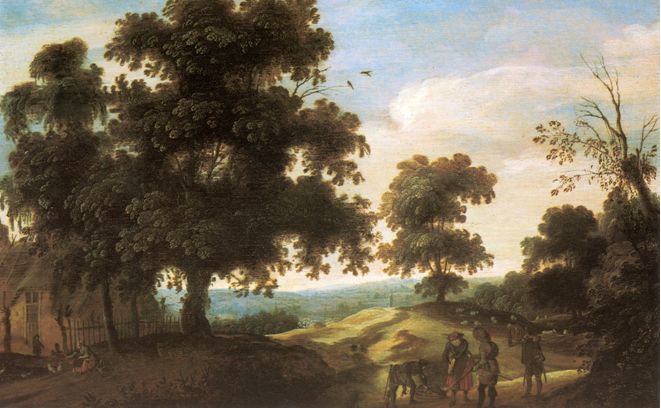
Country landscape
JACQUES FOUQUIER
(Antwerp 1585ca. – Paris 1659)
Oil on panel. 31 x 48,8 cm. (12,20 x 19,21 in.) 1612-15 ca.
Our table was made by Fouquier between the years 1612-15 for the similarity in terms of invoice with the painting that appears reproduced in Walter Bernt’s book (number 411 – Vol.I). The long tree in the center of the composition appears identical in our landscape.
Important Flemish artist specialized in landscapes. He was a disciple of Artus van Laeck in Antwerp. In 1614 he appears as a teacher of the Guild of Saint Luke of Antwerp. In 1616 he became a citizen of Brussels and registered in the local guild of painters. From 1616 to 1618 he worked for the Elector of the Heidelberg Palace. In March of 1619 he bought two lands for the archdukes Alberto and Isabel. Towards 1620 he worked in Paris. In 1626 he went to Toulon where he worked for Louis XIII to paint city scenes for the Louvre, a project in which he would compete years later with Poussin. In 1629 he worked in Marseille. In 1641-42 he painted a series of landscapes for the “Grand Galerie” of the Louvre. He had a fight with Poussin and died in poverty in the house of the painter Sylvain. Another painter M. van Plattenberg paid for his funeral. Fouquier had collaborated with P.P. Rubens in a landscape that belonged to the Kunsthist Museum in Vienna, but today is missing, this work is reflected in the inventory of the year 1659 of Archduke Leopold Wilhelm of Austria, it specifies that Rubens painted the nymph and the satyr in the landscape. Fouquier had two disciples: E. Rendu (active c.1647 / 70) and Ph. De Champaigne. In contrast to his drawings, Fouquier’s landscapes were very different. Many of his great works, painted during the second period of his career, were destroyed or are missing. A. Voet, J. van den Stock J. Morin made engravings of his paintings. His landscapes have a lot of influence from J. Momper and J. Brueghel I, but Fouquier makes them in a more vibrant way, with more color, but with less details. Towards the end of his life his style would be more classic.
BIBLIOGRAPHY
- Theme & Becker, Allgemeines Lexikon del Bildenden Künstler von der Antike bis zur Gegenwart, Vol. I. XXXVII, Leipzig, 1907-50
- Félibien, Entretiens sur les vies et les ouvrages des plus excellents peintres anciens & moderns, vol.I-III, Paris, 1686-88
- L. Hairs, Dans le sillage de Rubens. Les peintres d’histire anversois au XVIII siècle, Liège, 1978.
- Thiéry, Les peintres flemands de paysage au XVII siècle. Des précurseurs à Rubens, Brussels, 1986
- Berger, Inventar der Kunstsammlung, I, Vienna, 1883, p.CVI.
- Stechow, Jacques Fouquier in G.B.A., IV, 1948, pg. 419-434.
- E. Claessens, “Deux Points à éclaircir dans la vie du peintre flamand Jacues Fouquier (ca.1590-1659)”, en L’intermédiaire des généalogistes, nº 120, Nov 1965, pg. 305-307.
- Ember, “Un paysage de Jaques Fouquier au Musée des Beaux Arts”, in Bulletin du Musée Hongrois des Beaux-Arts, nº50, 1978, págs 63-72.
- Benezit, Dictionnaire des Peintres, Sculpteurs, Dessinateurs et Graveurs, Ed. Gründ, Paris, 1999, pág 611.
PROVENANCE
- Private Collection, Cologne.
MUSEUMS
There are works by Jaques Fouquier in the collections of museums in the following cities, among others: Bordeaux – Museum of Fine Arts, Cambridge – Fitzwilliam Museum, Cologne – Wallraf Richartz Museum, Ghent – Museum of Fine Arts, Heidelberg – Kurpfalzisches Museum, Karlsruhe – Staatliche Kunsthalle, Nantes- Museum of Fine Arts.