
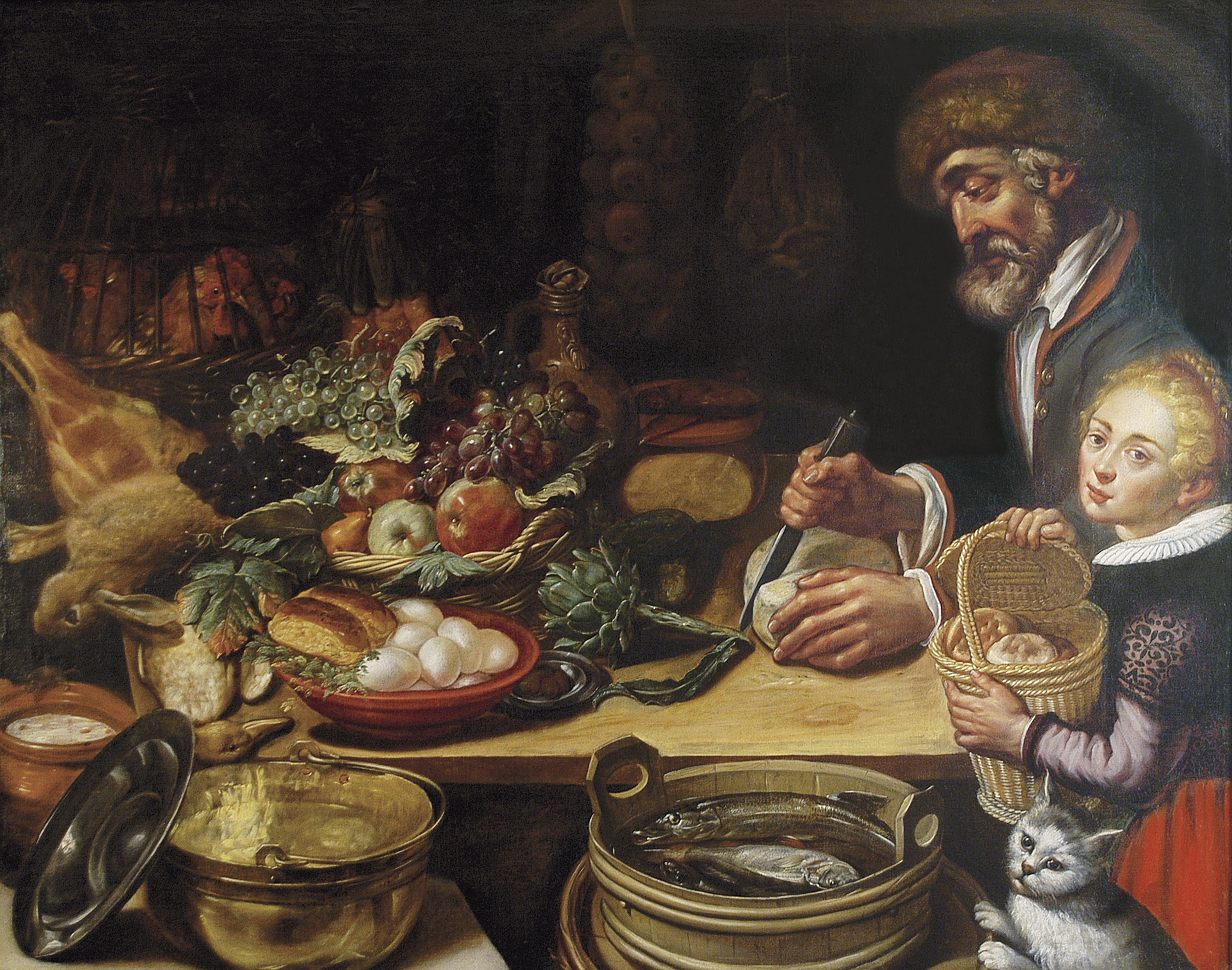
Kitchen Interior
PIETER CORNELISZ VAN RIJCK
(Delft 1568 – Italy ca. 1637)
Oil on Canvas. 106 cm. x 134 cm. 1620 ca.
This magnificent painting combines the harmony of a still life that includes fruits, vegetables, and even fish with a daily life scene. The daily life scene in this work is probably the relationship of father and daughter in a kitchen environment. Kitchen interiors show in a rudimentary way the typical aspects of still lives. This work shows the typical items found in kitchens such as varied fruits, copper pots, pitchers, pewter plates, clay platters with eggs and bread, etc. The works that show interiors also unveil the homes socioeconomic condition; the viewer is able to know if the house shown belongs to a bourgeois family or a feudal family pretending to live an elevated lifestyle. This theme was one of the most common representations in the Dutch Golden Age as food and its production and procurement was a common struggle.
Pieter Cornelisz van Rijck is an important Dutch artist who specialized in still lifes. Van Rijck’s works are very similar to those by P. Aertsen and J. Beuckelaer. Using the available documentation of the time, it is known that the artist travelled to Italy in 1588, moving to Venice until 1602 when he returned to Haarlem. According to the documentation of the time, the only source of information comes from van Mander. It is known that the artist was in touch with Jacob Williemsz in the city of Delft. Three years later he became Huybrecht Jacobsz’s pupil and subsequently worked with Grimanni. It was with him that he travelled to Italy in 1588, moving to Venice until 1602. In Venice Rijck became truly inspired and influenced by Bassani in his works. In 1602, the painter returned to Haarlem where he worked on commissioned works that were highly demanded at the time, particularly his portraits and interesting kitchen interior compositions. There is no information regarding the city or year of his death, but the last available reports suggest that he was last seen in Naples between 1632 and 1637. The Italian influence is very evident through the style in which each kitchen interior is painted. The artist portrays each utensil and food item with great care alongside the kitchen staff. Within Rijck’s repertoire, it is common to see sumptuous food buffets that illustrate the parable of the Rich Man and Lazarus or the Prodigal Son. The artist’s still lives are filled with meats and kitchen utensils that make his works very amusing and interesting. By looking at the work the viewer is able to see what the people of the time ate and how society lived. Other painters who created similar compositions include Cornelis Jacobsz Delft and Floris van Schooten.
BIBLIOGRAPHY
- B.W. Meijer, “Pieter Cornelisz. van Rijck and Venice”, Oud Holland 113 (1999), p. 137-152
- M.E.W. Goosens, “Schilders en de markt”. Haarlem 1605-1635, Den Haag 2001, p. 431
- I. van Thiel-Stroman, “Pieter Cornelisz de Rijck” in: “Painting in Haarlem” 1500-1850. The collection of the Frans Hals Museum, Gent-Haarlem 2006, p. 277-278
- Thieme/Becker 1907-1950 , dl. 29 (1935), p. 251 (Rijck, Pieter Cornelisz. van)
- Witt Checklist 1978 , p. 269 (Rijck or Ryck, Pieter Cornelisz. van)
- Saur 1999-2000 , dl. 8, p. 397 (Rijck, Pieter Cornelisz. van)
- Willigen/Meijer, “A Dictionary of Dutch and Flemish Still-Life Painters Working on Oils 1525-1725”, 2003 , p. 168 (Pieter van Rijck)
- E. Benezit, “Dictionaire des Peintres, Sculpteurs Dessinateurs et Graveurs”, 1999, Vol. 12, p. 134.
- Donna R.Barnes & Peter G.Rose, “Master of Taste” Food and Drink in Seventeenth Century – Century Dutch Art and Life” , 2002, p. 116-117
- Christopher Wright, “Dutch Painting in the Seventeenth Century”, “Images of a Golden Age in British Collection”s, 1989, p. 241
- Norbert Schneider, “Naturaleza Muerta”, p.49
PROVENANCE
Private Collection, Italy
EXHIBITIONS
Madrid, Soraya Cartategui Gallery, Feriarte, November 2014.
MUSEUMS
Pieter Cornelisz van Rijck’s works can be found in many museums around the world including: Amsterda- Rijksmuseum, Gante- Museum voor Schone Kunsten), etc.