
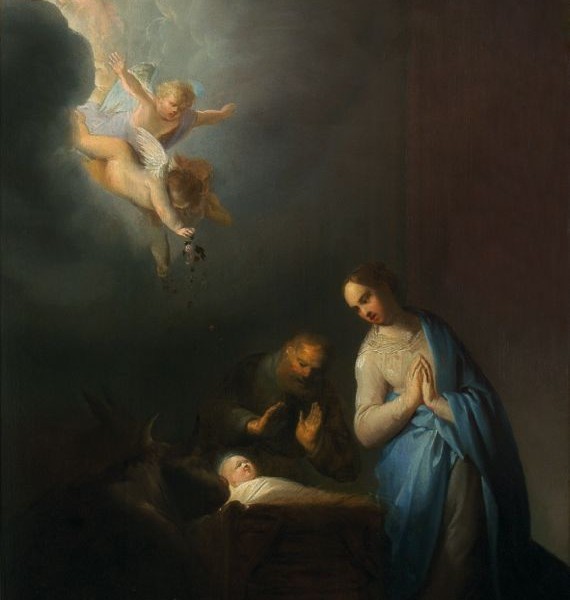
Nativity
(Haarlem 1600ca. – 1653)
Oil on Panel. 84 cm. x 60 cm. Signed work with Initials and Dated 163(.)
Nativity is a signed and dated work 163_; the fourth digit is illegible but the painting’s style and composition allows us to date it to 1634 because it is the last year of the “Rembrandt period” of Grebber. Interestingly enough, the painter never had direct contact with the circle of Rembrandt of his time, but their influence is very evident. There is a painting that represents the Adoration of the Shepherds that is signed and dated 1633 that is currently at the Catharijneconvent of Utrecht. That piece’s small flying angels are similar to those shown in this work, Nativity. It is important to mention that Julius H. Weitzner previously owned this work. Mr. Weitzner was born in New York in 1895 and studied chemical engineering but soon enough discovered a hidden passion for art. He became a prominent collector and a main figure in the art market. Towards 1920, the collector left his work as an engineer and began his long and successful career as an art dealer. Mr. Weitzner opened his first gallery in Manhattan and became one of the collectors with the best antique works in the United States and later on in London, where he moved in 1952 and died in 1986.
Pieter de Grebber is an important Dutch artist who developed most of his artistic career in the city of Haarlem. His father was Frans Pietersz de Grebber (1573–1643), a painter, art dealer, and embroiderer in Haarlem. Frans Pietersz de Grebber was Pieter’s teacher as well as that of his siblings, Albert and Maria. He also served as teacher to Pieter Jansz Saenredam and Judith Leyster’s. The artist has an academic style, influenced by the Flemish school and specifically by the followers of Rembrandt. Grebber was Hendrick Golzius’s student. According to the documentation of the time, it is known that in 1632 he became part of the Guild of Saint Luke of Antwerp. The painter specialized in creating religious, allegorical, and landscape works. Grebber is most recognized for his biblical scenes with elongated figures, pastoral landscapes with shepherds and their flock of cattle, and mothers holding their child. The artist focused on painting altarpieces for clandestine Catholic churches in the Netherlands, known as Schuilkerk. Grebber also executed commissioned works for Fredrick Henry, the stadtholder(a political role in the Netherlands). Because of this it can be inferred that he worked from 1638 to 1650 in The Hague and further that he participated in the decoration and art curation of the palaces in Noordeinde and Huis ten Bosch. Despite his specialization in painting sacred and historical scenes, approximately twenty of Grebber’s portraits still exist; most of these portraits are of priests and some are illustrations or prints. He also created the illustrations for at least one tapestry and ceiling decoration. Grebber was highly influenced by the Caravaggist school of Utrecht and was able to develop his own personal style characterized by the clarity in each composition and the use of a soft color palette. Along with Salomon de Bray he was one of the most distinguished figures in the “classicism of Haarlem”. Although the artist focused on diverse themes, he always took into account every small detail in order to create a balanced and beautiful composition. Grebber was a great master in the painting of figures; he is able to give life to each character through their expressive faces. Color was a very important factor in the works; soft hues are combined with strong light. These effects are emphasized by the brush intensity that is able to create a very special texture. Grebber had several disciples; one of the most accomplished was Nicolaes Berchem.
BIBLIOGRAPHY
- E. Benezit, “Dictionnaire des peintres, esculpteurs, graveurs et dessinateurs”, Vol. 6, 1999, p. 401
- Walther Bernt, “The Netherlandish Painters of Seventeenth Century”, 1969 Vol. 1 p. 46-47, plates 450 – 451
- Christopher Wright, “Dutch Painting in the Seventeenth Century, Images of a Golden Age in British Collections”, p. 198
- Essentiel, “Dictionnaire de la peinture flamande et hollandaise”, Larousse, París 1989
- Abrams, Aurora, “Dutch Paintings in Soviet Museums”, 1982, p.143
- Die Ausgentellen Werke, “Gemäldegalerie Alte Meister Dresden”, 2006, p. 286
- “All the paintings of the Rijksmuseum in Amsterdam”, A completely illustrated catalogue, 1976, p. 248
- Van Eck, Xander, “Clandestine esplendor: paintings for the Catholic Church in the Duch Republic”, Zwolle, Waanders Publisher, 2008
PROVENANCE
- Private Collection, London
- Julius H. Weitzner Collection
EXHIBITIONS
Madrid, Soraya Cartategui Gallery, Feriarte, November 2014.
MUSEUMS
Pieter Grebber’s works can be found in many museums around the world including: Amsterdam-Rijksmuseum, Bordeaux, Budapest- Museum of Fine Arts, Dresden- Antique Masters Gallery, Haarlem- Frans Hals Museum, Leiden, Paris- Louvre Museum, Stockholm, Kalunga, Birmingham- Barber Institute, London- National Gallery, Courtauld Institute, Manchester- City Art Gallery, Utrecht- Museum Catharijneconvent, Weert- Museum voor Religieuze Kunst Jacob van Horne.