
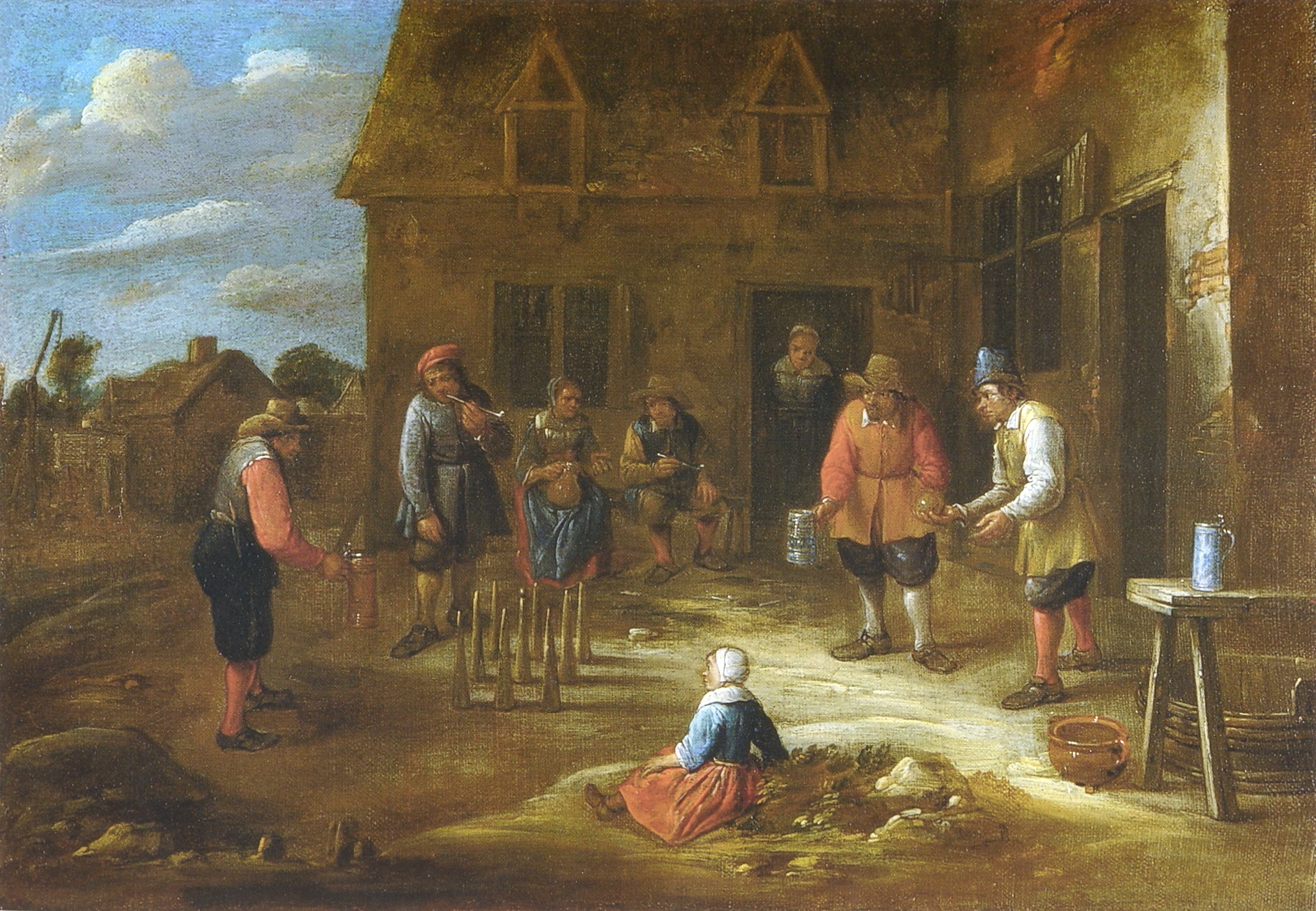
Peasants bowling
GILLIS VAN TILBORGH
(Brussels? 1625-1678)
Oil on canvas. 37,8 x 53 cm. (14,88 x 20,86 in.) 1670 ca. Registered in the RKD
Gillis van Tilborgh was one of the most important Flemish painters of the 17th century, specializing in portraits and genre scenes. Son and student of the painter Gillis van Tilborgh (The Elder), he also studied with David Teniers II (1610-1690). In March 1654 he appears registered as a citizen of Brussels and that is why it is believed that he was born there, in the same year he was appointed Master of the local Guild of St. Luke of which he lost the dean in 1663. In June 1666 , was in charge of the painting collection of Tervueren Castle (Brussels), the residence of the Habsburg governor, a position previously held by his master David Teniers II for the art-loving Archduke Leopold Wilhelm.
From the writings of the time, it is known that Gillis van Tilborgh II ran an important painting workshop in Brussels, where his pupils would later become very prominent painters. In 1670 he traveled to England, a fact that documents a work in which the important Tichborne family appears giving alms.
Tilborgh’s artistic production dates from 1650 to 1671, already in his time he enjoyed great prestige and received commissions from the most important noble families. The theme of his works is very rich, we find group portraits, guard scenes, town parties, tavern scenes, image galleries, etc. His genre scenes are clearly influenced by J. Van Craesbeck (1605-1654 / 1662) and D. Teniers II (1610-1690), in which like the latter he moved away from traditional depictions of peasants as rude uneducated towards a more idealized perception. His elegant family portraits resemble those of Gonzales Coques (1614 / 1618-1684), with great chromatic richness and detail, in which he often inserted beautiful allegories.
After his stay at Tervueren castle he specialized in painting for galleries or art collections, known as kunstkammer, a genre characteristic of Antwerp. These paintings represent large elegant rooms in which works of art and precious objects, stories such as scientific elements, natural specimens or jewels of great value are exhibited. Some of these works contain portraits of the owners and art collectors or even of the painters.
The paintings are loaded with symbolism and allegory and are a reflection of the intellectual preoccupations of the time, including the cultivation of personal virtue and the importance of knowledge. Although in Tilborgh’s work his intention is more allegorical than testimonial, as evidenced by The Artist’s Studio (Copenhagen, Statens Museum for Kunst) where the figure of the painter at the easel acts as an allegory of painting.
His compositions are very careful, keeping the figures in great harmony with the decoration, whether indoors or outdoors. He was known for his balanced palette, exact drawing, and compositional skills. He created a special style in the group portraits of the gentry of his time. In the genre scenes, the figures are drawn with a more relaxed character, in the style of David Ryckaert (1612-1661). Color and light are very important in his works, bright and warm tones, which create a special atmosphere in his interiors. He had numerous students such as Jan van der Bruggen (1662) and Jean Frayenborch (1660), among others.
BIBLIOGRAPHY
– J. De Maere & M. Wabbes, Illustrated Dictionary of 17th Century Flemish Painters, p.
396, plates 1178, 1179.
– M. Díaz Padrón, y M. Royo-Villanova, David Teniers, Jan Brueghel y los gabinetes
de pinturas, Madrid, Museo del Prado, 1992.
– H, Vlieghe, Arte y arquitectura flamenca, 1585-1700, Madrid, Cátedra, 2000
– P. C. Sutton, Pinturas holandesas y flamencas: la colección de Willem Baron Van
Dedem, Frances Lincoln ltd, 2002, p. 47
– R. Leppert, La vista del sonido: música, representación e historia del cuerpo,
University of California Press, 1 de noviembre de 1999, po. 29–31
– Z. v. M, Theme & Becker, vol. 33, 1939, p.167
– A. Houbraken, De groote schouburgh der Nederlantsche konstschilders en
schilderessen … zijnde een vervolg op het schilderboek van K. van Mander, vol. 1,
1718, p.222
– S. Speth- Holterhoff, Les peintre flamands de Cabinet d´amateurs …, París – Bruselas,
1957.
– F.C. Legrand, Les peintres flamands de genere …, Bruselas 1963, pag.160 -167
– Walther Bernt, The Netherlandish Painters of the Seventeenth Century, Vol. 3 pag.
117, plates 1180, 1181.
-E. Benezit, Dictionnaire des Peintres…, 1999, tomo 13 pag. 646.
– R. H- Wilenski, Flemish Painters, 1960, Vol. 2, pág. 670.
PROVENANCE
– Private collection, London (England).
– Private collection, Zaragoza (Spain).
MUSEUMS
There are works by Gillis van Tilborgh in the collections of the Museums of the following cities, among others: Musèe de la Picardie, Amiens (France) – Royal Museum of Fine Arts, Antwerp (Belgium) – Royal Museum of Fine Arts, Brussels (Belgium) – Boijmans Van Beuningen Museum, Rotterdam (Netherlands) – Statens Museum for Kunst, Copenhagen (Denmark) – Hessisches Landesmuseum, Darmstadt (Germany) – Musèe de la Chartreuse, Douai (France) – Staatl. Kunstsmlg, Dresden (Germany) – University Collection, Glasgow (Scotland) – Kunstthalle, Hamburg (Germany) – Alte Pinacothek, Munich (Germany) – Museum of Fine Arts, The Hague (Belgium) – Alte Pinakothek, Monaco (Monaco) – Metropolitan Museum, New York (USA) – Nàrodnì Galerie, Prague (Czech Republic) – Galleria Borghese, Rome (Italy) – Hermitage Museum, Saint Petersburg (Russia) – Museum of Fine Arts, Dunkirk (France) – Bridgewater House, London (England) ) – Museum of Fine Arts, Quimper (France) – Mauritshuis., The Hague (Belgium) – Szépmüvészeti Museum, Budapest (Hungary), etc.