
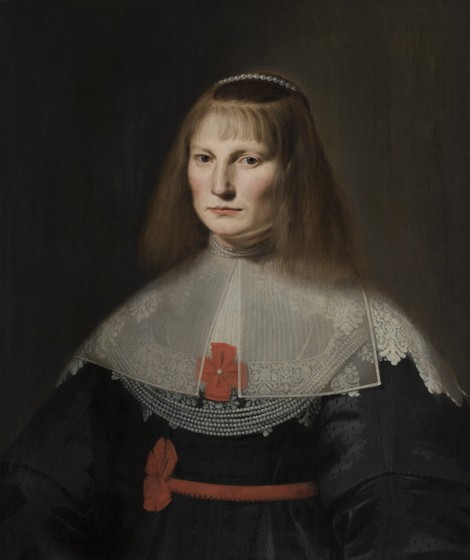
Portrait of lady
WYBRAND DE GEEST (Leeuwarden 1592 – 1661)
Oil on panel. 72 x 59,5 cm. (28,34 x 23,42 in.) 1645 ca. Resgistered in the RKD
Our work represents a beautiful portrait on a neutral background. The lady with elegant expression looks directly at the viewer. She wears a rich gown very adorned with jewelery, embroidery and fine, masterfully painted transparencies. The colors used are based on an austere chromatic range to see that elegant, starring black and white, with details of ornaments on the dress made in red. It is a half-length portrait that, due to the posture of the lady, lets us see her high manners and that she would belong to an upper class of society.
Outstanding Friesian painter specializing in portraits. Son of Simon Juckes, a glass painter from Antwerp, who also became his first teacher. He studied with Abraham Blomaert in the city of Utrecht, and his works have been confused on numerous occasions. Geest traveled to numerous cities with the Grand Tour, including Paris, Belgium and Italy. This fact is evident in the influence of his works by numerous artists such as Leonard Bramer, who contributed a drawing and a poetic composition.
On his trip to Rome he was part of the Schildersbent (group of painters formed in Rome) with the nickname “De Friesche Adelaar” (The Friesian eagle).
He returned to Leeuwarden in 1621, where he became the favorite portrait painter of the city’s upper class and landowners in the area. Together with some painters from his circle, he made portraits of the Nassau Counts of Friesland and the nobility that surrounded them.
On August 19, 1622, he married Hendrickje Fransdr Uylenburgh, the older sister of Saskia van Uylenburgh, Rembrandt’s wife. In 1634, shortly before his own marriage, Rembrandt visited his studio.
Towards the middle of the 17th century the genre of the pastoral portrait became popular, especially with regard to children: Wybrand de Geest also specialized in this type of portraiture. He painted in a style similar to that of Dirck Santvoort and Paulus Moreelse. In this way he acquired wealth and popularity and was skillful enough to ally himself with the most important aristocratic families of Friesland.
His works are characterized by individual portraits or groups of families with very strong figures, and usually, large black eyes. His faces are clean and realistic with a very accurate brushstroke where the drawing takes center stage. In his portraits, we usually find figures of the upper bourgeoisie, with sumptuous clothes and poses characterized by great sobriety.
BIBLIOGRAPHY
– W. Bernt, The Netherlandish Painters of the Seventeenth Century, Phaidon, Múnich 1970, p. 42.
– Reasoned Catalog, All the paintings of the Rijksmuseum in Amsterdam, Rijksmuseum, 1976, p. 237.
– L. Vries, Wybrand de Geest. De Friessche Adelaar. Leeuwarden, De Tille. 1982.
– C. Hofstede de Groot, Het vriendenalbum van Wibrand Symonszoon de Geest, Oud-Holland 7 (1889), p. 235-240
– G.J. Hoogewerff, De stichting der Nederlandsche Schildersbent te Rome, Feestbundel dr. Abraham Bredius, Amsterdam 1915, vol. 1, p. 109-125, esp. p. 13
– P. De Keyser, De kunsthistorische betekenis van Den getrouwen Leidsman in Rome van Wibrand de Geest de Jonge, Gentse Bijdragen tot de kunstgeschiedenis, 11 (1945-1948), p. 185-206 (résumé en français)
– L. De Pauw-De Veen, Den grondt der edel vry schilder-const van Karel van Mander en Den leermeester der schilderkonst van Wibrandus de geest : een korte vergelijking, Revue belge de philologie et d’histoire, 34 (1956), p. 363-384
– A. Wassenbergh, Wybrand Simonsz. de Geest, De portretkunst in Friesland in de zeventiende eeuw, Lochem 1967, p. 30-40
– R.E.O. Ekkart, review of De Vries 1982, Oud Holland 98 (1984), p. 249-252
– P. Bakker, De Friese adel en de schilderkunst in de Gouden Eeuw: een verkenning, Virtus. Jaarboek voor adelsgeschiedenis 15 (2008), p. 43-71
– S. Rus, Het album amicorum van Wybrand de Geeste. Een uniek reisdocument, De Vrije Fries 94 (2014), p. 31-59
– C. de Jong, De betekenis van het kostuum in de portretten van Wybrand de Geest, Kostuum 2013, p. 6-21
PROVENANCE
– Antique dealers market, Holland 1993.
– Luigi Caretto Gallery, Turin (Italy)
– Private collection, Asti, Piedmont (Italy) from 1999 to 2020.
MUSEUMS
There are works by Wybrand de Geest in the collections of the museums of the following cities, among others: Museo Nacional del Prado, Madrid – Louvre Museum, Paris – National Museum of Fine Arts, Antwerp – Hermitage Museum, Saint Petersburg – Hunterian Museum , Glasgow – Staatliche Kunstsammlungen, Kassel. Abbeville – Mus. Boycher of Perthes, Antwerp – Convention of Zwartzusters, Bruges – Church of St. Walburgis, London – Buckingham Palace, Mechelen – Church of Groot Beginjnhof, Lille – Museum of Fine Arts, The Hague – Mauritshuis, Vienna – Gg. Der Akaemie, Dunkerque – Museum of Fine Arts, Culemborg – St. Barbara’s Church, Munich – Alte Pin. , Saint-Omer – Sandelin Museum.