
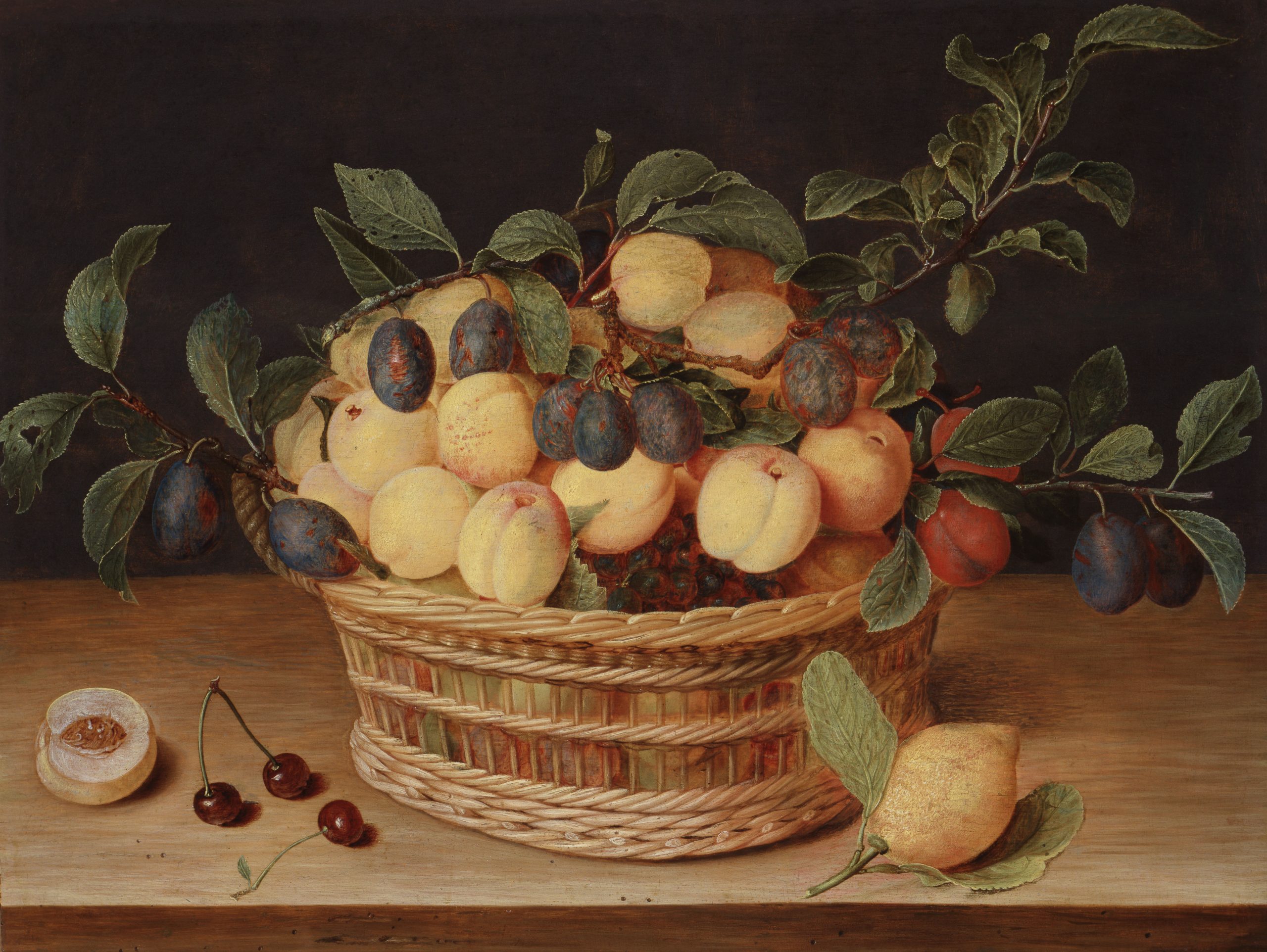
Still life with fruits
JACOB VAN HULSDONCK
(Antwerp 1582 – 1647)
Oil on panel. 41 x 55 cm. (16,14 x 21,65 in.) 1625 ca.
Thanks to Fred G. Meijer for confirming the authorship of the work. Archived at the RKD as Jacob van Hulsdonck. Exhibited at TEFAF Maastricht
Jacob van Husldonck was born in Antwerp in 1582. He moved to Middelburg with his parents at a young age and there he likely received at least part of his training. For the longest time our work had been attributed to Ambrosius Bosschaert who was the city’s most prominent still life painter. However, although his influence on Hulsdonck is undisputed, today it is believed that the artist did not train with Bosschaert. In 1608 he went back to Antwerp, where he lived and worked for the rest of his life. In the same year he also joined the Guild of Saint Luke. Van Hulsdonck’s artistic personality is inextricably linked to the specific sub-genre of the still life of fruit. He can perhaps be regarded as the most prominent representative of this genre outside of Italy. Starting from a raised and deliberately rigid spatial setting, the artist comes to create rich compositions that are characterized by the desire to cram into a container as much fruit as possible so as to immediately convey the feeling of fullness and fragile balance. He was also clearly influenced by Osaias Beert and Jan Brueghel I, specifically with regards to the rendering of different surfaces and the material thickness of lemons, peaches, leaves, barks, fiber and so on.
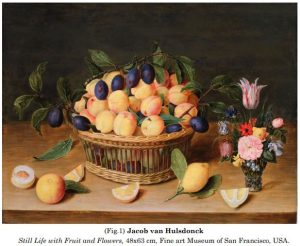
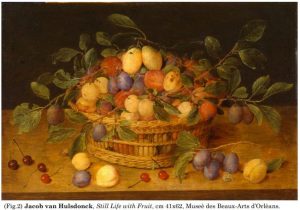
Our refined basket is no exception, on the contrary, it masterfully exemplifies the artist’s style, prompting further comparisons. Based on the artist’s way of working, his still lifes can be divided into groups categorised according to their setting and genre, within which the artist rearranged and changed a few details, while keeping a substantial underlying consistency.
The variations kept in the museum of Orleans (Fig.1) and in San Francisco (Fig.2) are considered twins to our magnificent panel. They merely differ in some of the colours and for the presence of a small vase of flowers. It has long been debated whether these still lifes can be somewhat connected to the vanitas, whose most famous example is undoubtedly the Basket of Fruit by Caravaggio. Nevertheless, today these remarks are not considerate to accurately describe van Hulsdonck’s art, who instead fits better within the “formalist” style, interested in investigating the inner meaning of objects’ aesthetic in space and what it is able to communicate to the observer. Following in the footsteps of his contemporaries ! the great Dutch and Flemish masters ! the artist focuses on compositions that, as Charles Sterling clarified in 1992, convey “a poetic emotion in front of the relationship that the artist has been able to create between the beauty of these objects and their arrangement”. He thus sets himself apart from some contemporaries like Frans Snyders, who gathered around the baroque movement with new scenic compositions. Hulsdonck is quite similar to Louyse Moillon and it is likely that their art fed off of each other’s.These matters can be noticed in our painting: the dark background and the minimalistic environment allow us to focus on the variety, richness and beauty of nature. Cherries, plums, grapes and lemons come together and give life to a musical composition balanced between realism and abstract ideas. Despite the abundance of fruit, the painter displays a genuine concern in lightening the composition through the addition of various leafy branches, thus infusing in the painting an ethereal atmosphere. The colours are fascinating, the fruits are vivid as well as appetizing. The artist undoubtedly shows a very strong desire to make everything like a trompe-l’oeil, never exceeding the limit of a conspicuous and slightly surreal deception, a silent deal between artist and observer.
BIBLIOGRAPHY
- Bernt, W., ‘The Netherlandish Painters of the Seventeenth Century’, vol. 2 (1969), p. 60.
- Rombouts, Ph. Lerius, Th., ‘De Liggeren en andere historische archieven der Antwerpsche Sint Lucasgilde = Les Liggeren et autres archives historiques de la Gilde Anversoise de Saint Luc’, vol. 1 (1961), pp. 447, 497, 500, 542.
- Van den Branden, F., ‘Historia de la escuela de pintura de Amberes’, 1883, pp. 637-639.
- Wurzbach, A., ‘Niederländisches Künstler-Lexikon auf Grund archivalischer Forschungen bearbeitet’, vol. 1, (1906-1911) p.734.
- Thieme, U., Becker, F., Catálogo razonado ‘Allgemeines Lexikon der bildenden Künstler : von der Antike bis zur Gegenwart’, vol. 18 (1925) p. 113.
- Maere, H., Wabbes, M., ‘Illustrated Dictionary of 17th Century Flemish Painters’, Bruselas 1994, p. 223.
- J. van der, AA., ‘Biographisch woordenboek der Nederlanden, bevattende levensbeschrijvingen van zoodanige personen, die zich op eenigerlei wijze in ons vaderland hebben vermaard gemaakt’ vol. 8, 2 (1867), p. 1439
- Briels. J., ‘Pintores flamencos y los albores del Siglo de Oro holandés 1585-1630’, 1997, p. 342.
- Meijer, F. G., ‘Jacob van Hulsdonck, Still life on a plain table of a Wanli period dish filled with raisins, dried figs and almonds, with bread, slices of sugared preserved melon, raisins and almonds strewn on the table, with a bluebottle on the melon’, 2016 enWayback Machine. at Richard Green
- Willigen, A., Meijer, F. G., ‘Diccionario de bodegones holandeses y flamencos que trabajan al óleo: 1525-17’, 2003, p. 11425
- Beyer, A., Savoy. B., ‘Saur: Allgemeines Künstlerlexikon : die bildenden Künstler aller Zeiten und Völker’, vol. 75 (2012), p. 454.
PROVENANCE
- Private collection, Brescia, Italy.
EXPOSICIONES
– TEFAF Maastricht, 2022
MUSEUMS
There are works by Jacob van Hulsdonck in the Collections of museums in the following cities, among others: Bowes Barnard Castle Museum, Teesdale (England) – State Museum, Berlin (Germany) – Dahlem Museum, Berlin (Germany) – J. P. Getty Museum, California (USA) – Metropolitan Museum, New York (USA) – Alta Pinacoteca, Munich (Germany) – Museum of Fine Arts, Orleans (USA) – Bredius Museum, The Hague (Netherlands) – Rijksmuseum Twenthe, Enschede (Netherlands) – Museum of Art, Cleveland (USA) – National Gallery of Art, Washington D.C. (USA) – Bavaria State Art Collections, Munich (Germany), etc.