The Deposition
MASTER OF THE PROGIDAL SON
(Active in Antwerp from 1530 to 1560)
Oil on Panel. 111,1 x 72,4 cm. (43,74 x 28,50 in.) 1535 ca. Expertise by Peter van den Brink
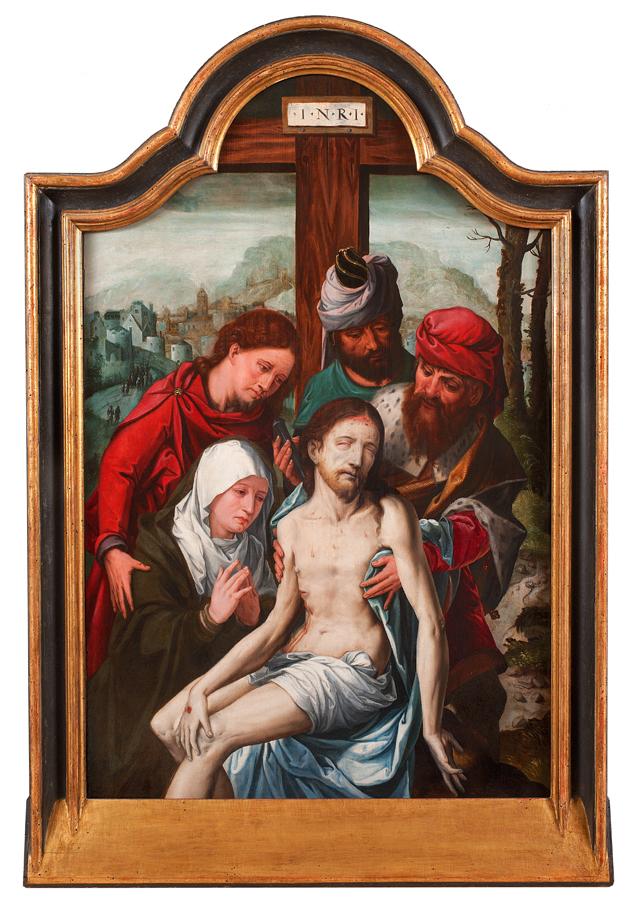
The beautiful, lifeless body of Christ lies gently on a sheet of light blue tones, surrounded by four figures gazing at him. His wounds suggest that his stooped posture and half-closed eyes do not indicate that he is asleep, but that he has passed away. The cold tones alternate with the bright crimson, metallic black and violet of his attire. The nails and the cross place us on Golgotha, outside the walls of Jerusalem. 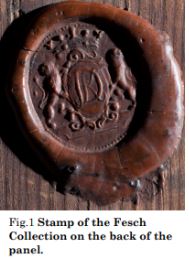 Its considerable size and remarkable state of preservation, as well as the fact that it comes from the prestigious collection of Cardinal Joseph Fesch (as evidenced by the seal on the reverse, Fig. 1), reaffirm what the style and quality of the painting had already shown us.
The craftsmanship in the depiction of the tears running down the faces of Mary and St. John is deliberately related to the archaic tradition of the Flemish Primitives, as are the precious materials in the dress of the wealthy Joseph of Arimathea on the right, draped in a cloak of brocaded furs. Brown-haired Nicodemus, with his coiled turban, holds the nails of the cross in his hand, as he contemplates the wounds in Christ’s forehead. The dramatic atmosphere is made vibrant by these compositional and chromatic devices, as demanded by devotio moderna, a particular form of private worship that had become increasingly popular in Flanders in the 16th century and required works of art for private meditation.
Authors such as the Master of the Prodigal Son were able to respond to the great demand for artworks suitable for this type of worship. It is likely that our work was conceived to ornament a private chapel. In this sense, it is necessary to go deeper into the subject.
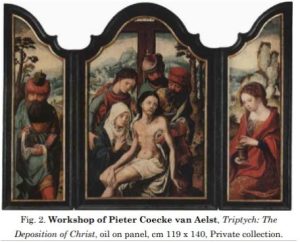
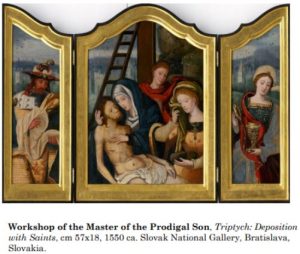
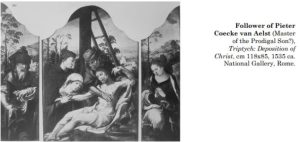
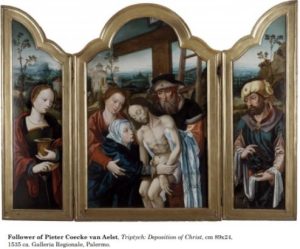
The work, which dates from the author’s youth, between 1535 and 1540, reveals the profound influence of Pieter Coecke in the choice of the cut of the composition and the placement of the foreshortened characters, almost as if they were in a natural setting with a broad landscape as a backdrop. The panel was probably part of a triptych. Its exterior panels must have been removed for commercial reasons before the 20th century. This undoubtedly confirms the widespread use of religious triptychs with the same theme, from the most common to the most singular. Moreover, only one other version of our work (of inferior quality) is known and is currently attributed to the workshop of Pieter Coeckhop (Fig. 2). It is identical to ours in the number of characters and general features, but differs in the choice of colors, details, authorship and landscape retouching.
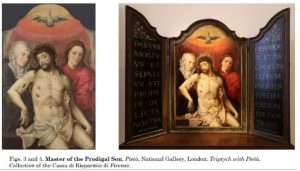
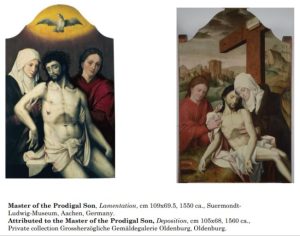
Therefore, it seems logical to assume that the Master may have seen this triptych in Antwerp, and then translated the scheme into his own style to create a specific and genuine work, very different from works datable to the 1550s that are sometimes quite repetitive (Figs. 3 and 4).
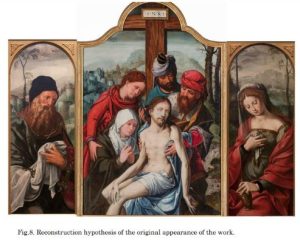
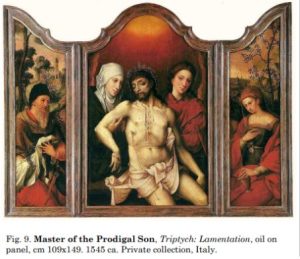
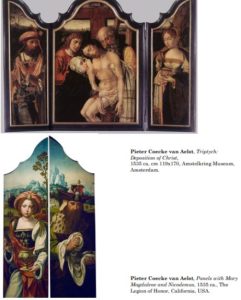
If we also compare the aforementioned triptych with the one currently preserved in the Wallraf Richartz Museum (Fig. 5) and with the corresponding one from a private collection (Fig. 9, Comparisons), the original appearance of our table can be appreciated. 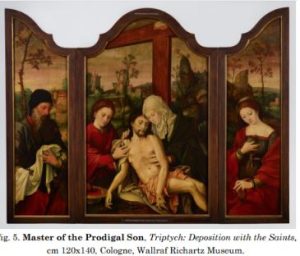 The central scene culminates with Mary Magdalene, on the right panel, and an elderly saint, on the left, turning towards the main scene, transmitting a continuity that is also confirmed by the landscape in the background, which is always conceived in a unitary way from one side of the triptych to the other.
Many other similar cases support our reconstruction with an evocative hypothesis. Two side panels of a triptych, the central part of which is unknown, are preserved in the collections of the Pushkin Museum. The two panels became part of the Russian royal collections after 1854. After that, the panels changed ownership several times. During one of these sales, the panels were transferred on canvas, following a custom typical of Russian restorers. It was probably modified by cutting off the upper part in a circular shape, so that they were more independent of the missing central part. 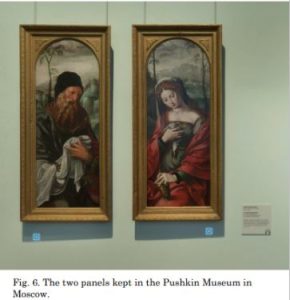
Its current height is 88 centimeters, but it could have easily reached 111 centimeters like our painting, if it had not been cut. In addition, the style of the two panels are strongly related to our work, both sharing a monumental style. The chiaroscuro of the faces, the light coming from the same direction (with an identical play of shadows on the body of Christ and the figure of Mary Magdalene), the plasticity of the flesh and the large hands, the identical representation of the precious details reveal an obvious stylistic link. Not to mention that, according to our reconstruction, our painting would be a more than plausible variation of the aforementioned triptych (Fig. 8). In support of our theory, note the background landscape that extends across the three panels, both in terms of color palette and in terms of coloring and architectural structures. The city, with its walls, extends from the center to the left panel, behind the bearded old man, while on the opposite side the mountains give way to the trees from right to left behind Mary Magdalene.
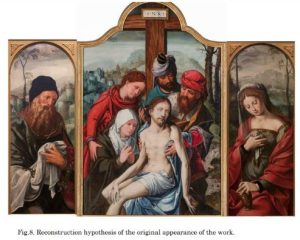
This hypothesis will have to be definitively proven by the technical analysis of the two panels. However, the great overall quality of the three panels is undoubtedly enhanced by their juxtaposition and allows us to affirm this work as an anthology of the Master of the Prodigal Son.
.
Pictures of comparative artworks:
Important Flemish painter of the last generation of Flemish primitives. Active in Antwerp between the 30s and 60s of the sixteenth century. Specialist in religious compositions, mythological and allegorical scenes. He was called Master of the Prodigal Son, Georges Hulin de Loo, who in 1909, from a painting preserved in the Kunsthiostorisches Museum in Vienna began to draw up a catalog raisonné of one of the most fascinating and distinctive painters. According to documentation of the time we know that he may have spent time in Mantua, Pisa and Rome. His paintings are associated with different artists of his time such as Pieter Aersten, Jan Mandijn and Lenaert Kroes. His style belongs to what is known as the “Romanist style”, which was very fashionable in Flanders from the third decade of the 16th century thanks to artists such as Frans Floris, Marten van Heemskerck, Maerten de Vos, Jan Massys and Jan Mandijn, all of whom had a clear “mannerist” tendency. The artists belonging to this movement worked in large workshops, which allowed the diffusion of their plastic model outside Flanders, reaching especially the Iberian Peninsula with a purely sacred iconography.
The painter’s artistic profile is the result of several influences, as he witnessed a crucial moment of transition between the refinement of the Antwerp Mannerist school to the more mature spatialism of Pieter Coeck van Aelst, of whose style the Master can be considered the most brilliant guardian and who was responsible for the transmission of this legacy to later artists such as Pieter Aertsen.
Between 1540 and 1550, the Maestro presumably directed an important and productive workshop, to which we owe some of the best known compositions of the time. These works do not all have the same level of quality, which indicates that he must have had the help of his assistants and collaborators.
The difference between the paintings of the workshop and those of the author becomes evident when looking at high-level and internationally certified works such as ours, which can be considered a masterpiece. Some of the unmistakable characteristics of the Master’s works are: descriptive but synthetic realism, sharp and thick contours with marked shadows, the use of colors in a dramatic and emotional key, his fondness for compositions developed on the vertical axis and the play of spatial oppositions.
BIBLIOGRAPHY
– R. H. Wilenski, Flemish Painters, 1960, 2. Vol
– G. Marlier, L’Atelier du Maitre du fils Prodigue, Jaarboeck, Koninklijk Museum vor Schone Kunsten, 1961, pp. 75-80
– G. Delmarcel, Flemish Tapestry from the 15th to the 18th Century, Lannoo Uitgeverij, 1999.
– G. Ring, Der Meister des Verlorenen Sohnes, Jan Mandyn und Lenaert Kroes, Jahrbuch für Kunstwissenschaft, Leipzig, 1923, pp. 196-201.
– M. L. Contenson-Hallopeau, La Parabole du Festin par le Maître du fils prodigue, Revue du Louvre et des Musées de France, vol. XXXII, n.º 4, París, 1982, pp. 273-277.
– Matías Díaz Padrón, Nuevas Pinturas Identificadas del Maestro del Hijo Pródigo, Goya Revista de Arte, Madrid, Nº 159, 1980.
– E. Benezit, Dictionnaire des Peintres, Sculpteurs, Dessinateurs et Graveurs, Ed. Gründ, París, 1999, Vol. 9, pp. 53-54.
– A. Volckaert, De Meester van de verloren Zoon en de Brusselse wandtapijtkunst, Jaarboek van het Koninklijk Museum voor Schone Kunsten Antwerpen 1987, pp. 93-106.
– V. Bermejo, E. Angulo, R. Lamarca, Una nueva tabla del Maestro del Hijo Prodigo (taller) en el Instituto Ephialte: su modelo iconografico, Archivo Español de Arte 67 (1994), pp. 176-181.
– E. Bermejo, Pinturas inéditas del siglo XVI: Benson, Pieter Coecke y el Maestro del Hijo Pródigo, Archivo Español de Arte 69 (1996), pp. 249-267.
– A. Diéguez Rodríguez, Una parábola de las mujeres prudentes y necias des Maestro del Hijo Pródigo en el obispado de brujas, Boletfn Museo e Instituto “Camón Aznar” (2007), nr. 100, pp. 29-38.
PROVENANCE
– Cardinal Joseph Fesch Collection, Rome (Italy) 19th century.
EXHIBITIONS
– TEFAF, Maastricht, 2022
MUSEUMS
There are works by the Master of the Prodigal Son in the collections of the Museums of the following cities, among others: National Gallery, Dublin (Ireland) – National Gallery, London (England) – Museo del Prado, Madrid (Spain) – Kunsthistorisches Museum, Vienna (Austria), Royal Museum of Fine Arts, Brussels (Belgium) – Royal Museum of Fine Arts, Antwerp (Belgium) – Museum of Fine Arts, Valenciennes (France) – National Gallery, Bratislava (Slovakia) – Museum of Fine Arts, Pau (France), etc.