
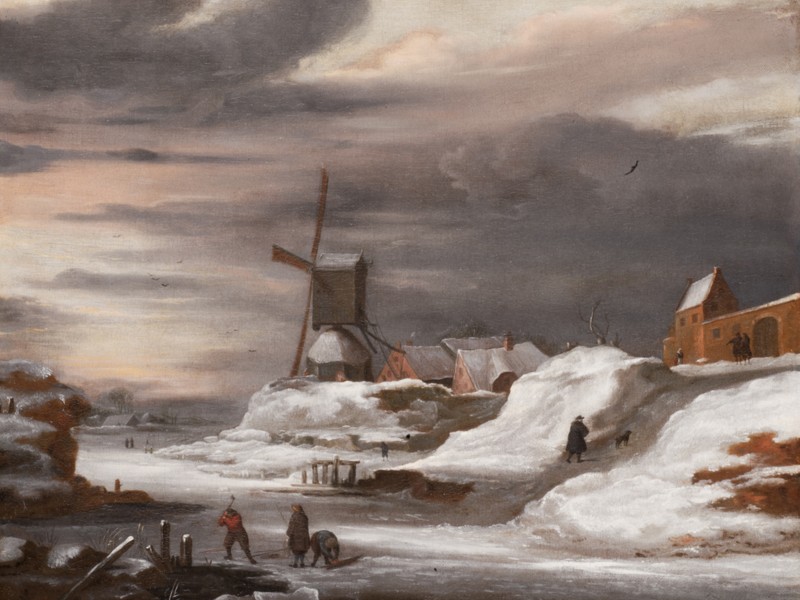
Winter Landscapes with Figures
(Amsterdam 1641 – 1680)
Oil on Canvas. 42 x 52 cm. Signed work with signature trace. 1670 ca.
The winter landscapes of the Dutch Golden Age are at times a reminder of the historic event known as “The Small Ice Age” because there were two terribly cold winters. The first winter was in 1607-08 and the second one was in 1620-21. These tragic events became an inspiration for landscape artists who decided to recreate the happening.
As Walter Bernt states in The Netherlandish Painters of the Seventeenth Century”, there were many works by Jan van Kessel where his signature was erased and substituted by Jakob van Ruisdael; this painting is an example of it. When it comes to composition, the artist is able to capture the winter atmosphere perfectly by using different color tones to create the grey sky.
Important Dutch painter who specialized in landscapes and spent most of his artistic career in the city of Amsterdam. Experts believe he was Jacob van Ruisdael’s student because both share a similar style. Kessel’s landscapes are known for having a radical light contrast and paying close attention to every small detail. The artist’s popular landscapes show a dune in the foreground and in the back a horizon line made out of lighter colors that are able to stretch out the city’s silhouette. These works might remind the viewer of those panoramic landscapes by Jacob van Ruisdael, Philips Koninck, and Jan Vermeer “The Elder” of Haarlem. Due to the superposition of levels, Kessel is able to create great depth in the landscapes, which was typical technique amongst Golden Age Dutch landscape painters. It is also common at times to find a wide range of landscapes such as wooded views of mountains with waterfalls that are similar to works by Ruisdael or Allaert van Everdingen during their last period. Kessel enjoyed painting city views where he could recreate all details and play with color tones to provide a magnificent perspective. These types of compositions have some sort of resemblance to those by Claes Hals. After conducting several studies, it is known that in many of Kessel’s works the signature was erased and substituted by de Jacob van Ruisdael or J. van del Haagen’s signature. For example, just by a slight alteration in the monogram J. v. K. Following the trends of the time, artists specialized in more than one subject and collaborated amongst each other. In some of J. Kessel III’s works, the figures have been painted by Johannes Lingelbach, who also collaborated with many artists.
BIBLIOGRAPHY
- Walther Bernt, “The Netherlandish Painters of the Deventeenth Century”, Vol. 2, p.80, plates 777, 778
- Davies, “Jan van Kessel”, 1992
- W. Stechow, “Dutch Landscape Painting of the Seventeenth Century”, 1966, London, p. 48E. Benezit, “Dictionnaire des peintres, sculpteurs…”, 1999, Tomo 9, p.716 y 717
- N. MacLaren, “National Gallery Catalogues, Dutch School”, London, 1960, p. 206
- Christopher Wright “Dutch Painting in the Seventeenth Century Images of a Golden Age in British Colletions” p. 210
PROVENANCE
Private Collection, París
MUSEUMS
Jan van Kessel III’s works can be found in many museums around the world including: Antwerp- Royal Museum of Fine Arts, Amsterdam- Historical Museum, Rijksmuseum, Brussels- d’Ixelles Museum, Budapest- Museum of Fine Arts, Cologne- Wallraf-Richartz Museum, Krakow- National Museum, Dublin- National Gallery, Dulwich- Dulwich Pictures Gallery, Glasgow- Glasgow Art Gallery, London- National Gallery, National Trust, Monaco- Alte Pinakothek, Paris- Louvre Museum, Rotterdam- Museum Boymans van Beuningen, Saint Petersburg- Hermitage.